
I’m both an author and a reader, and I’ve had Opinions™ about chapters for years. I’m not going to pretend I cracked the code on what actually makes the perfect chapter – a lot of this will be genre, author, and project dependent – but here are two major considerations to keep in mind when you’re writing a chapter… or as a reader, things you know the author considered when crafting their story.
I know as an author, when I’m working on a chapter, there are a few main considerations I have. The first is probably the most obvious – what does the chapter add to the story? I sit advancing the plot? Is it revealing more info about a character? And I’m rather self-indulgent, so is it something that maybe isn’t strictly necessary but is fun? That’s obviously step one, and it’s the central part of actually writing the chapter. I’m not going to go into this atm and I’m sure there are far better writers than I who could talk about how to properly structure a chapter’s events and flow (I go by vibes only, sorry).
What I’m going to talk about here are chapter length and chapter titles.
Chapter Length
One of the things that helps me decide if a chapter is done is the length. Usually, I write out what I was planning to for the next chunk of the story, then I check the word count. If it’s too low, I might decide to add on another piece of story before I say the “chapter” is done; if it’s too high, I’ll consider breaking it into separate chapters.
But what exactly makes a chapter “too” long or short?
Obviously I have my own opinions on chapter length, but because I absolutely love seeing what other people think, I posted a poll on Tumblr to get an idea of what readers prefer: long or shorter chapters.
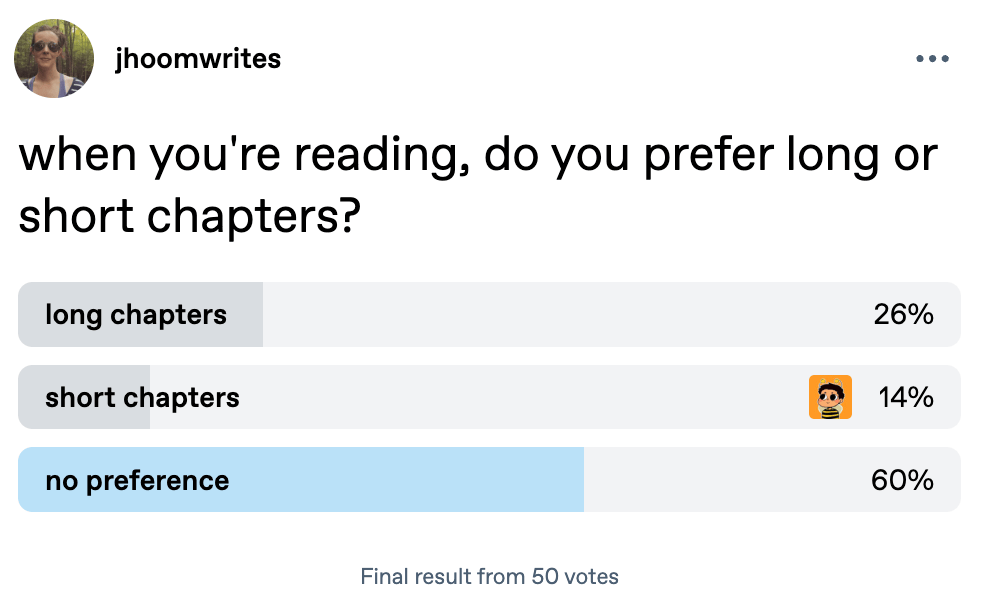
Click here to view the full poll.
As always, reader preferences are just that – preferences. I know I personally am flexible with what I read and write, because I know genres and individual stories (as well as an author’s style) will exert pressure on the story. A romance chapter that’s 10,000 words is probably a bit much; a similarly long chapter in a fantasy book, and I wouldn’t bat an eye.
When I read these results, I take into account this was a 1-day poll posted on Tumblr. Tumblr is a fandom-centric place, so I put on my fandom hat when I think about the results. I know that personally, as someone who has subscribed to MANY fics that were being posted over the course of days or weeks or months, when I got that notification that there was an update, I wanted a LONG update. I’ve been waiting! I’m impatient! Gimme gimme gimme. As a writer of those serially updated fics, I kept that in mind before posting updates. I looked at how long it’d been since I last updated the story, and if I felt my new chapter was too short given the wait, I’d add more. I would NOT post an update below 2.5k on AO3. I wanted to make it worth the wait, so I’d push to that minimum.
I know that personally, as a reader with a book in my hands or a fic on my phone, I prefer short chapters. There’s a little feeling of accomplishment when you get to the end, right? There are definitely chapters that are too short – give me more than a couple pages – but I think I’m more likely to encounter ones that are too long. Pages and pages (and pages…) with no breaks? It can feel exhausting. That long, to me personally it feels like there’s just too much going on. It’s like winding up a rubber band too tightly, and the longer the chapter goes, the more I seek that release of pressure.
I need breaks! Just for the sake of my eyes. If I get a book and the paragraphs are too long (cough I, Claudius cough), it’s just so hard to read it, no matter how good it is. I also have the very real problem of being old and very tired lol – I read before bed, and there is a good chance I will pass out before I finish more than a couple pages. Give me breaks (mid-chapter breaks are fine!!!) so I stand a chance of getting to one of those before I fall asleep, otherwise I’m going to spend some of my precious reading time figuring out where I left off and what’s going on.
As an author, I do try to keep the chapter length in mind. I want to have some sort of consistency within the same book (so that if a chapter is really long or really short in comparison, it packs a little more oompf). For my novels, I normally just write out the action/info I planned to get through and don’t worry about the length, because I’m typically within the same range throughout that book. Part of why I was thinking about chapters lately was as I went to edit No Line Change. It’s a heavy mix of traditional 3rd person POV and social media/text messages – I didn’t write it as chapters, I wrote it as chunks of events. As I went to break things down into chapters during alpha reads and edits, I was super conscious of the lengths because it varied a lot more than usual. I have some really short 1k chapters and some really long 4k+ chapters, and I had to make decisions on “okay, do I want the lengths to be consistent or do I just need to group them in a logical way that flows/connects ideas?”
Before I pull numbers, I’ll say that 2,500-3,500 words per chapter is the sweet spot I usually go for in hockey romance. Let’s see if I hit it 🙂
Chapter Lengths:
- The Trade Deadline: 2,163 words per chapter (40 chapters + social media stuff + prologue + epilogue)
- Drop the Gloves: 2,014 words per chapter (47 chapters + epilogue)
- No Line Change: 1,799 words per chapter (76 chapters + epilogue)
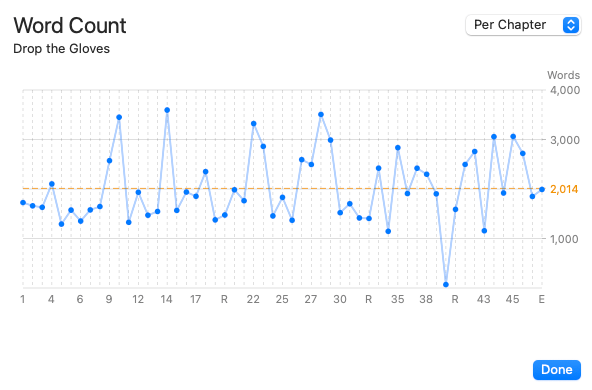
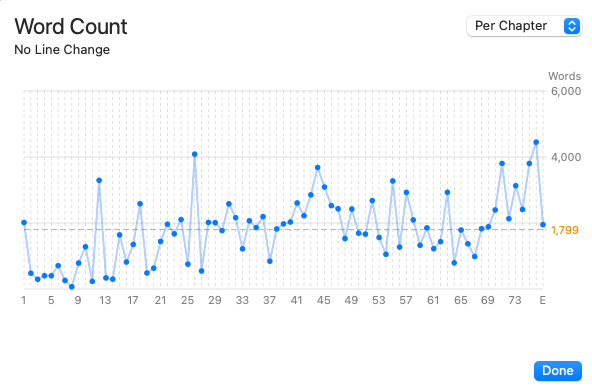
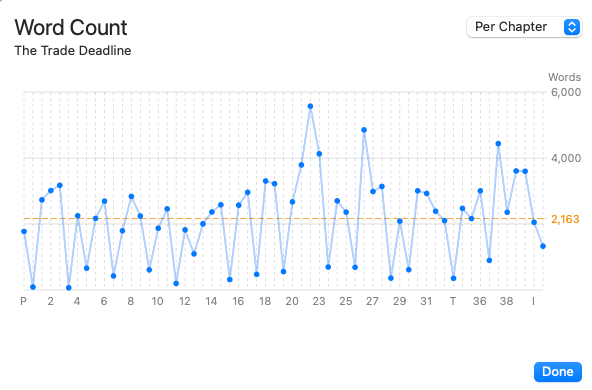
I am apparently below my “sweet spot” on average in all three books lol Though for both TTD and NLC there are a lot of “social media” chapters that are super short competing with “normal” chapters.
Will having this data make me change anything? Not at all – like I said, I write based on vibes and what I feel like is a completed story chunk. Since I’m not writing serially anymore, I’m not worried if an individual chapter is too long or too short (…much, I was a little worried as I constructed NLC) because everything is available all at once, there’s no long wait between chapters. And since I often try slightly different narrative structures for my books, I’m not trying to make them uniform to each other, anyway.
It’s just some data and considerations for fun 🙂
Chapter Titles
Another consideration is naming the chapter. This reflects how the chapter slots into the story as a whole, and sometimes genre conventions dictate what type of chapter titles people use/prefer.
There are a few chapter title types:
- no title, just numbers
- a phrase or quote related to the content of the chapter
- grounding info (name of character, location, and/or date)
Here are the results of the Tumblr poll on chapter titles (click here to view the poll).
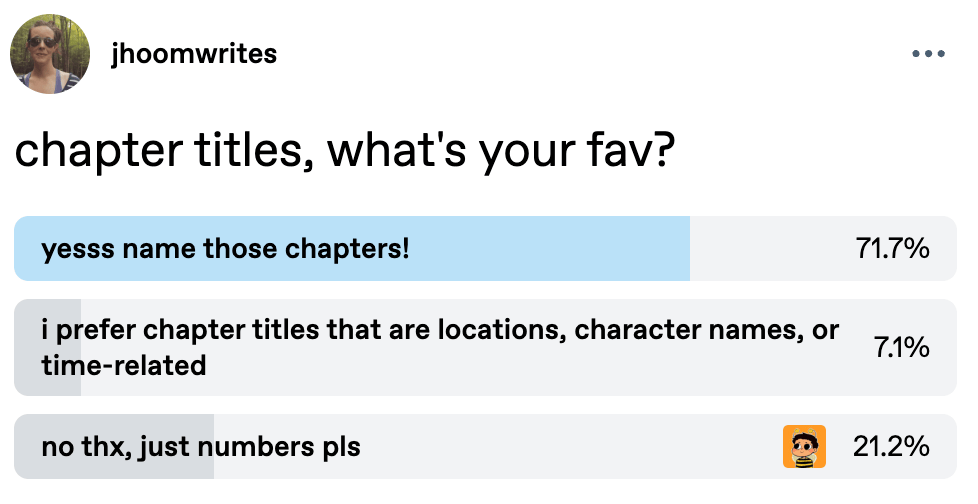
Obviously in a story that takes place across multiple point of view characters (Game of Thrones and other epic fantasies), that info is important. In a lot of mysteries and thrillers I’ve read where there are two timelines, the date is super helpful knowing if the chapter is “present” or at some point in the past leading up to main events. I do think chapter titles are cute – they’re like episode titles for TV shows – but I’ve also read books where the chapter titles were ABSOLUTE spoilers, and that’s just no fun.
In romance books, I tend to see just numbered chapter headers, or maybe the character’s name if you have a dual POV (which honestly isn’t necessary in a lot of books – the style is usually to alternate POVs, and I try to make it clear early in a chapter who the POV character is so there’s no second-guessing).
When I’m reading a book, I am up for whatever the author’s preference is. I think chapter titles can be cute and work really well; numbers are fine (though I don’t keep track of what number I’m on or the total); in some genres, I rely on those name/location/date info (and in general just find them interesting).
In my own work, I tend to go very barebones. Chapter numbers are my preference, but I also like organizing things by the date. Hockey stories especially, I know I have to be super conscious of the general timeframe so I’m scheduling their game schedule appropriately. My ideal is also to have things take place over the course of a single season, basically August – July if I include pre-season, post-season, and/or off-season stuff. Does my ideal work out? Apparently not often XD
Chapter Titles in my Books
- Numbered: The Trade Deadline, Vampires Don’t Play Hockey, Drop the Gloves
- Character Names: Tessa of Hundrfeld (whole series will be this way, though I’d also considered adding in dates and locations), Drop the Gloves (just Riley’s chapters get his name)
- Dates: Hockey Bois (months or other Big Events), No Line Change (I’m not going to lie, this book is all over the place – there are some chapters that designate time, then every chapter until the next time listed is within that time frame, meaning lots of chapters are just a number)
For each of these, I considered the genre (epic fantasy vs hockey romance, for example) and then the individual structure of the story (I wanted to do months as chapters in NLC, for example, but that led to wildly different chapter lengths, some of them over 10k…). For most of them, it was easiest to just number the chapters.
It also makes it difficult when some chapters/events bridge multiple months, a thing that can definitely happen in NHL playoffs depending on the series lengths. And naming the chapters by month (or listing any dates) can back me into a wall. If I don’t pin down exact dates, I have more flexibility (looking at you, NLC) and I don’t run into weird scenarios where they’re playing hockey when maybe they shouldn’t have a game.
(While I’m actually working on the draft, the chapters do have titles – but they are usually summaries so I can easily find things. I have numerous “dat first time” or “dat second time” titles throughout my books, or things like “playoffs round one.”)
tl;dr
As an author putting together the “perfect chapter,” I try to…
- content: advance the story (plot or characters)
- word count: if updating serially, make sure it’s long enough to balance out the wait; otherwise, try to be consistent within a project
- titles: make sure the kind of titles match genre conventions, label in a way that makes sense for that story, and don’t be afraid to put chapter titles 🙂
 A.L. Heard
Leave a comment