
Recently, I ran another poll on Tumblr. I asked people: You’re about to pick out a new romance to read – what’s MOST LIKELY to be a dealbreaker for you? So before you read on, consider what the biggest dealbreakers are for you when you go to pick up a new book. I listed some things that I notice about books and that others have expressed as considerations when deciding to pick up or put down a book.
As authors, we have to make several choices before we can start writing. Even if I have the whole book outlined and ready to go, even if I know my characters inside and out, I need to make some more mechanical style choices before I can start writing. I know as an author, I have preferences; I also know as a reader, I might have different ones.
I’m going to run through these terms—ideas that get thrown around a lot among readers/writers but aren’t necessarily explained often—and talk about my personal choices as a reader/author for each.
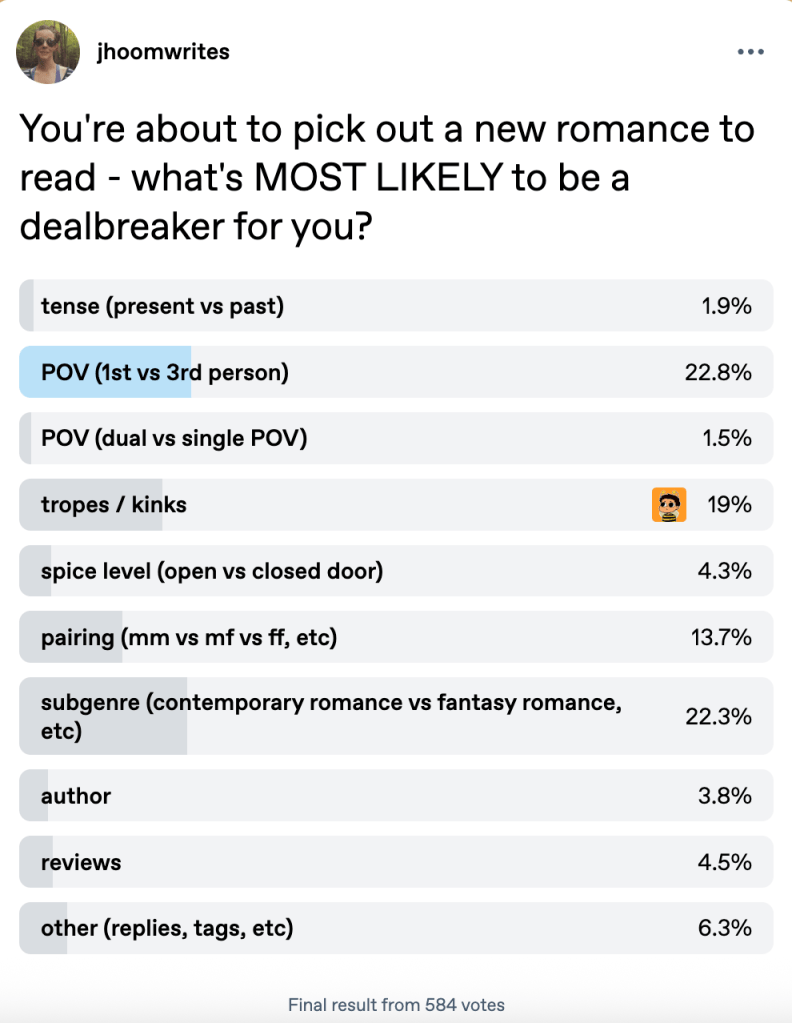
Click here to view the Tumblr Poll and read through the comments, replies, and tags.
Tense
This is an easier one. Tense refers to when the action takes place—generally either past tense (Lars walked into the rink) or present tense (Lars walks into the rink). Different genres tend to favor different tenses. Fantasy and historical fiction, for example, are ones I would expect in the past tense; contemporary and romance are a little more present tense leaning. The idea being that “past tense” stories are over, they’re done and being retold to you. Present tense has some immediacy to them, conveying the story is unfolding as you read it.
My reader preference: Don’t have one. It’s not a thing I really notice (though maybe I would if it’s one of those ones that goes against the expectation – a historical fiction novel in the present tense might stand out to be, but honestly I’m not 100% sure).
My writer preference: For novels, I tend to write in past tense. It just feels like the correct tense for my work. I actually started No Line Change with a chapter in the present tense that I’ll need to change to past tense, because when I wasn’t paying attention, the tenses changed pretty quickly. I do, however, notice that if I’m writing a short story that I intend to keep under 5k, I am more likely to jump into it with present tense. I think a lot of my May Trope Mayhem stories were present tense, for example.
Point of View
Okay, this is a big one and I’m going to break it into a few different categories. It’s more or less the viewpoint the story is told from, but there are different ways to convey that info.
1st vs 3rd Person
Let me put on my grammar teacher hat for this one. 1st person is “I/we” while 3rd person is “he/she/it/they.” For this one, there’s again some genre conventions in place. A lot of romance these days is written in 1st person, more than I think in other genres. Like with tenses, there’s sort of an immediacy or distance that’s created with the distinction. 1st person is more intimate, where you’re in that person’s head, whereas 3rd person has more distance.
My Reader Preference: Don’t have one. When I’m reading a physical book or an ebook, I don’t know that I really notice either way. I do sometimes notice in audiobooks and am not a huge fan of 1st Person because sometimes I can’t tell if the person is thinking a thing or saying a thing because it’s always “I.” Sometimes I’ve had to make a guess and judge based on the other characters’ reactions to see if it was a thought or speech. I have guessed wrong.
My Writer Preference: I only write 3rd Person. It just fits better for me. I don’t have a good reason for it—sometimes 1st Person might be a little easier, so I don’t have so many dang he/him pronouns floating around during sex scenes—but it comes more naturally to me. I still have to get in the character’s head to write them properly, so it’s not really about distance. I’ve also done some 2nd Person POV when I write a Decide Your Fate novel, though I wouldn’t say that came easily to me.
Single vs Dual vs Multiple POV
The number of narrators in a story is also part of the POV. There are some books that are Single POV (only one character viewpoint), a lot of romances are Dual POV (both love interest viewpoints, usually alternating), and some books are Multiple POV (many character viewpoints, very common in epic fantasy).
My Reader Preference: Again, don’t have one. I know a lot of people prefer a Dual POV for romances, and I do enjoy that, but I also think it gives things a bit more mystery and angst when it’s single POV. You, just like the protagonist, have to guess at the intentions, thoughts, and motives of the other love interest. I’ve seen some people say they don’t enjoy Single POV because they don’t feel like they can trust that the other person is actually in love without getting in their head…I do NOT buy into that at all. Actions and words count, and just like in real life where you can’t really know what someone’s thinking, those build up to tell you if there is or isn’t love there. I’m totally up for whatever the author thinks is the best set-up to tell their story.
My Writer Preference: I really do not have one haha – I’ve done single POV (Nick in Hockey Bois), dual POV (Lars and Ryan in The Trade Deadline), basically single POV (Evan with a few individual Riley chapters in Drop the Gloves), and multiple POV (Tessa of Hundrfeld). Usually it’s me picking the viewpoint(s) that will best serve the story. Sometimes, I go into a book with a specific plan where I want to try something new. The Trade Deadline, for example, was my first dual POV romance and I did it very intentionally, because both characters had their own baggage to unravel along with the romance. When I started No Line Change, I had decided early on that Dylan’s POV would be told only through text messages and Henri would get traditional chapters, just because I wanted to try it out.
Other Considerations
I’m grouping a bunch together here because they aren’t as writerly/technical, but still definitely interesting to talk about and real considerations for a lot of readers.
Tropes/Kinks: This isn’t an easy one to filter for without using StoryGraph. I know there are certain tropes I gravitate toward (teammates to lovers, only one bed, sunshine/grumpy, etc), and some that are mid-tier for me (not my fav but I’ll read it), and some that are dealbreakers for me (do NOT give me a story with cheating or surprise pregnancy pls pls pls). Same with kinks. I try to weed out my least fav tropes before I get the book (my mid-tier ones aren’t enough for me to DNF a book).
Subgenre: My poll was about what you’re looking for in a romance, and there are a lot of subgenres in romance. Whether you like a historical fiction, sports romance, contemporary romance, or romantasy, some pairings just speak to people more than others. I’m obviously a hockey romance girlie, but I dabble in others.
Spice Level: There are open door and closed door romances, and even among the open door romances there can be varying degrees of smut and varying levels of kinkiness. I am honestly game for anything, but usually like to know ahead of time. Sometimes a sweet romance hits the spot, and sometimes I want some seriously nsfw smut. Not so much a dealbreaker as a “not right now” read vs a “yessss give it to me” read. (If I’m reading fanfic, it better be super spicy lol that’s what I’m there for.)
Pairings: Again, the poll was specifically about romance, so the general pairings of MM, FF, or MF I think are big considerations. There are also poly books with MMF or MFF etc where love triangles (boo) get upgraded to “why choose?” (yay). I’ll read any of these, though I’m not a big MF romance reader these days. I don’t like a lot of the tropes that get used a lot in those romances, where as the Achillean and Sapphic books tend to have the tropes I am into.
Authors: Sometimes you find an author who gives you what you like, so you read all their stuff. Sometimes, that author has burned you and you don’t trust them. Sometimes, they’re hit or miss. There are a few authors I actually follow and will devour anything they write (this is mostly nonfiction tbh, but I will read any of Rachel Reid’s teammates to lovers books), and there are a bunch of authors I know personally whose books I read because I know them, but most of the time I’m not personally considering the author. I look at the premise, maybe read the first page, and I’m good to go with any author.
Reviews: There are lots of places like Goodreads and StoryGraph where you can read detailed reviews of what people think of the book. You can also get an average with the 5 Star ratings. I do prefer StoryGraph for having quarter stars, I do feel there should be more nuance than 3 or 4 stars, when we all know a 3.5 star book. As a reader, I only look up reviews AFTER I’ve read the book to see if people agreed with me (and this is usually for books I didn’t like and wonder if I’m crazy for hating the book). I will go off of friend recs if I know they have a similar book taste. As an author, I am scared to look at my own reviews. If I’m not promoing a new book, I don’t touch them. The good ones are great 🙂 and the bad ones make me think I should never write another word again.
What are your big considerations when you’re picking out a book to read (or if you’re an author, what do you prefer to write)? Are there any big ones I left out?


Leave a comment