
I attended a writer’s conference last year, one I’ve attended before but this time there was a critique session with other authors that I signed up for. There were a few things that one of the other authors in the session said that stuck with me. Some of what he said I dismissed outright — I read some of his work for the session too, and we write very different styles in very different genres, so a lot of it simply doesn’t fit — but something he said definitely stuck with me.
He said that he, as an author, doesn’t bother reading prologues or epilogues and most readers don’t either.
Which blew my mind. Because to me, that’s just part of the story so why wouldn’t you read part of the story? As an author especially, I feel like there’s a certain amount of understanding and respect you gain for what other authors are trying to do with their work, and saying you just won’t read them just feels dismissive of what they’re doing.
But I was willing to thing that was a one-off. A weird take from a guy who had several weird takes. Later, though, I saw it come up from other authors in other places, across several genres. And I was just…shocked?
To be clear, this wasn’t something that was ever said by someone running any of these panels or workshops at the conference. It’s normally authors saying what they felt to be true, almost as folk wisdom. So I decided to do some investigation and see if this reading convention is as prevalent as they seem to believe.
Do you read prologues/epilogues?
I conducted two polls, one on Instagram and one on Tumblr, asking if people read prologues, epilogues (both, just one or the other, neither). I tried not to bias it with my own opinion when I posted them, just the question and the options. I know there’s going to be some bias in my samples anyway, because I am an author posting in fandom and book circles, so my audience was going to mostly be readers. But that’s also kind of what I wanted – to know if people who read are indeed ignoring prologues/epilogues.
Here are the results of the two polls.
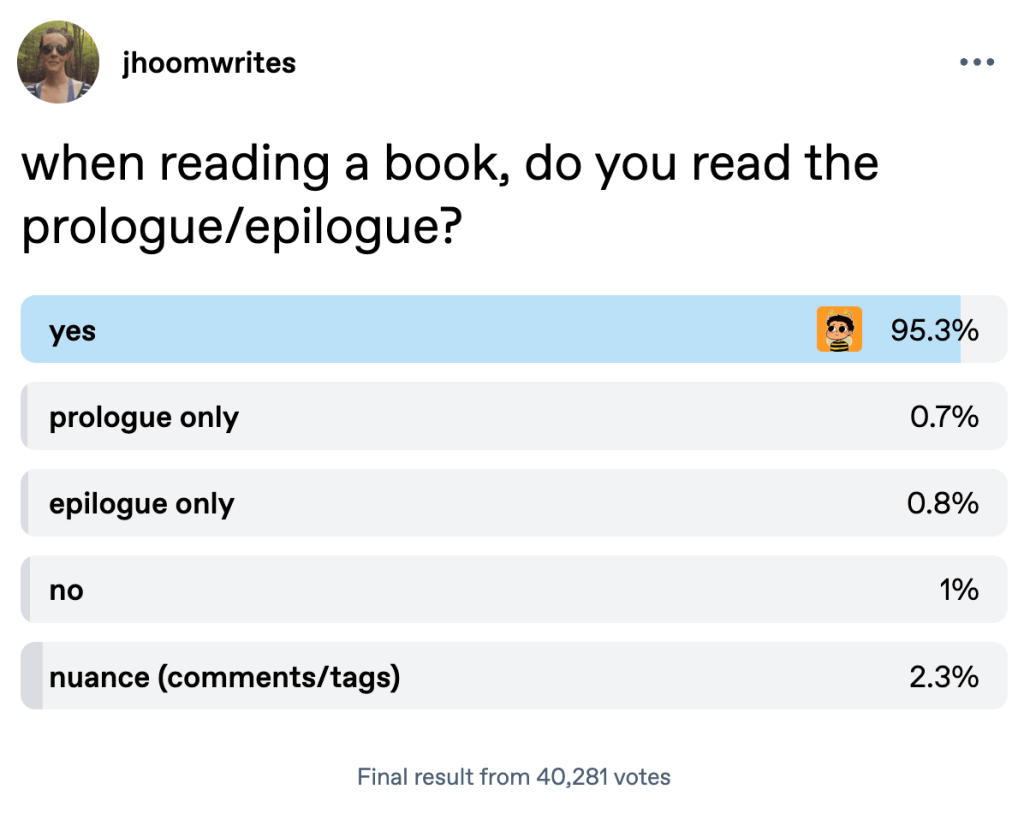
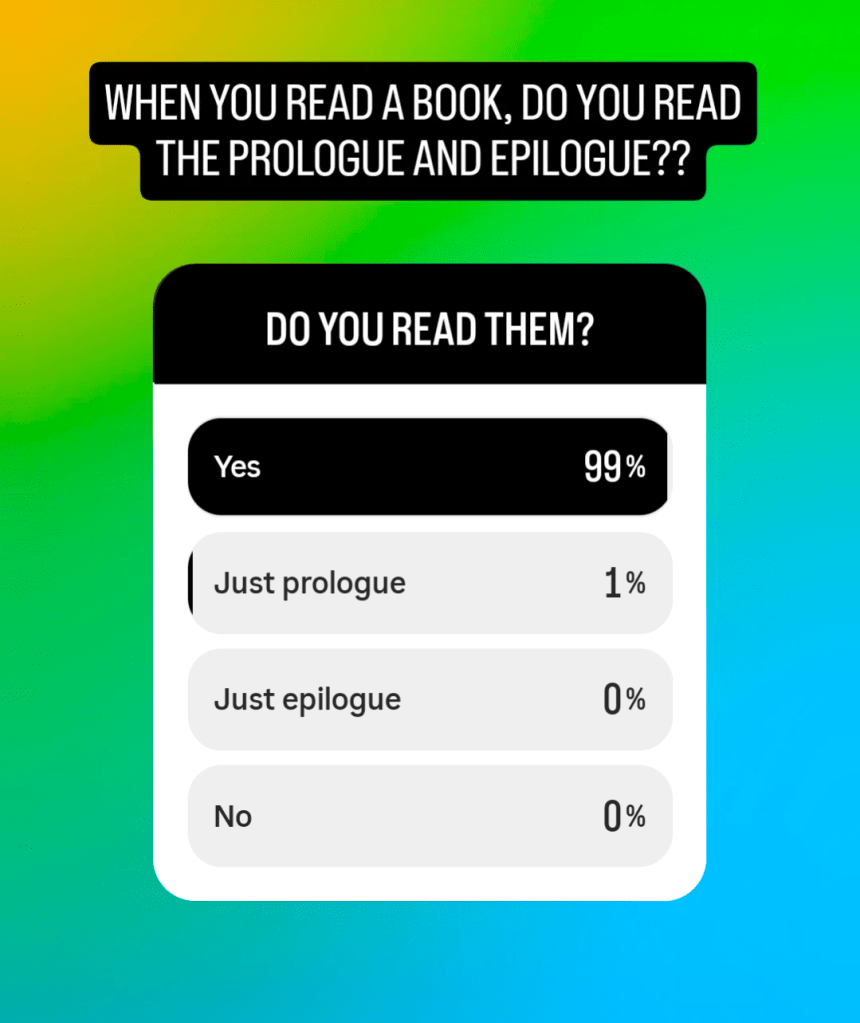
I would also recommend you visit the Tumblr poll to read the replies, reblogs, and hashtags to get a better idea of what people think about it and why.
I gotta say…I was kind of relieved? I enjoy reading and writing both prologues and epilogues, and I’m glad it seems most people do as well. But I also liked getting a chance to hear from people who DON’T enjoy them, or are maybe more selective about when they read them. I wanted to hear that viewpoint and not just that dismissive way those other authors said they don’t read them. People gave actual reasons, and while I don’t always agree, I can at least appreciate where they’re coming from.
What are prologues and epilogues?
One of the recurring things that came up in the polls was maybe a misunderstanding of what a prologue and epilogue are, and how they differ from similarly placed tools like a preface, foreword, afterword, acknowledgements, etc.
“If it were important, it’d be in the book.”
I got a lot of variations of that idea – the prologue and epilogue aren’t part of the “book” or “main story” and so are more optional than the actual chapters.
So I’m just here to say… they are part of the “real” story. And they ARE in the “real” book. In my general conception of what they are, they are 100% part of the story and the author is expecting you to read them as part of the experience. And please bear with me – I have no formal education in writing or editing. I have read and written a lot, but my degrees are unrelated to literature
The prologue is the cold open of the book. Think of it as the scrolling text before Star Wars movies. It’s grounding you in the world, typically at an earlier point of time than the rest of the novel, or perhaps from a different point of view. It’s a framing device that leads into the story, and it might have a different style than the rest of the novel. It might also be something where you get important info, but the payoff comes up much later in the novel.
The epilogue is the book’s closure. It’s usually a jump forward in time to see how the characters are doing now that they’ve settled into their lives after the end of the book. The time jump forward is usually helpful because we want to see something that hasn’t happened yet, but it would be too anti-climatic to get there the old fashioned way. Aside from that time jump, you might also see a shift in point of view or a different style than the main body of the text. To me, this is about loose ends and a peek into the future, a little treat at the end. And for romance, one that I think is kind of important.
Epilogues in Romance
I can’t 100% guarantee it, but as primarily a romance author, I see myself writing an epilogue to all of my romance novels. I think they are often an essential part of the story. When I get to the last chapter, where the characters are finally together and have confessed their love and are in that place where they are committed to each other, that’s great! But a huge factor for me in Happily Ever After vs Happy For Now is that epilogue. Sure, right now at this moment where the final chapter ends, they are happy. I want to jump ahead in the future to make sure they’ve carried that momentum forward into a strong relationship.
Do I need a big jump forward? Nope! I think a few months will do. I don’t need to go all the way to their deathbeds and have them reflect back on their children and grand-children etc etc. That’s too much. Just a little window into how their lives have shifted now that they are a couple.
Think of all the tension of their third act conflict. If they broke up, I’m worried that they’ll fall into the same bad habits that led to that breakup. I want to see that they’ve worked through their issues and come out stronger. If it was circumstances beyond their control, I want to see how they are handling those circumstances and maybe making sure they don’t happen again. Just something to squash my anxiety about their future.
This isn’t always necessary. Sometimes the ending of the novel is gradual enough or has built in answers to those questions already, and so they can get to The End without me having any more worries or questions. But if the book ends shortly after the love confession…give me a little something, y’know? Help ease me out of the story.
What about the other stuff?
The forewords, acknowledgements, etc? Those are, in my mind, notes about the author or their writing process, or maybe the historical context of the book itself (which you might find in a book written in another time period). If nonfiction, where you’re not even quite reading a story, it’s about giving context to the scope of the book. You might also find glossaries or maps or works cited. Not to say that all of those things aren’t valuable or add something to the reading experience, but they aren’t part of the “story.” If you were to film the novel as a show or movie, that information would not be included.
Admittedly, I am not a big Foreword, Afterword, or Acknowledgements girlie. Depending on the story and author, I might read them (my girls Mary Beard, Natalie Haynes, and Emma Southon doing the lord’s work of writing nonfiction in Classics from a female perspective… I read every word of every page, regardless of what it’s labeled), but I can see why those might be skipped. If I casually enjoyed a book, I will probably not read the acknowledgements at the end. If it’s a beloved author, I am much more likely to.
Author Trust
Another theme that came up in the online discussions I had and read relate to author trust : does the public trust the author to do a good job with prologues and epilogues. People mentioned having the book spoiled by a foreword/prologue, and so they don’t read them because that trust was broken. Prologue use can definitely vary based on genre. In some books with a lot of worldbuilding — fantasy or sci-fi, for example — you might have a lot of infodumping about lore and all of that. I can definitely get why page after page of background info before the story might not be appealing when you’re reading to jump into a new book. Fair enough.
Others talked about how they don’t like epilogues that show the future, because once the story ends, they want to be able to imagine their own ending for the characters in the future, and some epilogues have ruined that for them. They don’t want to see five, ten, twenty years in the future – they want to be left with the openness of imagining it themselves.
To a degree I get it. I think I’ve read some books and seen some movies where the “epilogues” have left me unsatisfied. They went too far in the future, or they didn’t do the characters credit (I am not here to rant about HIMYM……). But as a fanfiction author, I have never felt myself entirely bound by canon. I can still enjoy the characters and story, knowing all of the canon and then tweaking in my head the ways I think it could’ve been done more to my own personal satisfaction.
And I suppose the thing about trust is… if I don’t trust the author, why am I reading their story at all? If I don’t trust them to give me an enjoyable experience, why am I taking the time to read through hundreds of pages? If I read the prologue (Chapter 0, basically) and don’t like what the author is saying or how they choose to tell a story…why am I continuing on to Chapter 1?
My Own Books
I love both reading and writing a prologue and epilogue. So here’s how Prologues / Epilogues feature in my published novels so far – warning for spoilers!
Book: Hockey Bois
Prologue: ✖️
The book is completely grounded in Nick’s POV, so there was no additional pre-book timeline info that needed to be worked in. The story, as relevant to the book, starts in that first moment on page 1. Even if there were a Brady POV, the only bg info that’s relevant is his high school injury, and honestly I would want the reveal of that later on anyway.
Epilogue: ✅
They resolve the immediate conflicts in their relationship, have a heart-to-heart, and promise to try and make it work. Which is great! Except Brady is a flight risk! And they just had a third act breakup! So I jumped ahead a few months to show that they are in a much better place, andthey made use of that foundation to move their relationship in the right direction for long term happiness. Also I wanted the love confession 🙂
Book: The Trade Deadline
Prologue: ✅
I don’t know that this one is strictly necessary to put Ryan and Lars’ hookup in Juniors as an epilogue, but I did feel it was important to include it AND I think this was the easiest method to do it. I want the reader to know about it ahead of time, because then the reader can experience Ryan’s viewpoint of “this is a big deal” and the reveal of “omg Lars doesn’t even remember” which I think comes across best if it’s at the beginning and presented in a way that frames it almost as assumed knowledge. The book timeline is also pretty much a year (August pre-season through to June post-season) that a scene 7 years prior makes more sense as a prologue imho.
Epilogue: ✅
I think things are more stable in their relationship at the end of the book proper than they were for Nick and Brady, BUT there were other important elements of the book that I felt I could shed some light on. Ryan’s contract. Lars and Anders’ relationship. Ryan and Lars being out publicly as a couple. Again, just showing the next few months (the summer off-season) and their forward momentum as a lasting couple.
Book: Drop the Gloves
Prologue: ✖️
There’s only one pre-book thing I can think of that would’ve even made sense as a prologue (Riley’s hit on Evan in the previous season), but I think it makes more sense to allude to it than experience it from Evan’s eyes. It’s similar to The Trade Deadline in that it’s an event that’s important to their relationship that only one of them remembers, but even though he forgot, it was important to Lars and it’s surprising that he forgot; the hit left no impression on Riley because he doesn’t care, and honestly I don’t think it’s surprising he forgot about it. And even though it sours Evan’s impression of Riley, I don’t want that to happen for the reader.
Epilogue: ✅
Look. These two. Evan especially. They didn’t follow my outline. This book was supposed to run for a full season, just like The Trade Deadline, and these idiots resolved all of their relevant conflicts before Christmas. Neither has any particular playoff baggage, so there was no reason to push through to that; while Riley’s contract and tendency to move around is definitely a future roadblock for their relationship, it’s not relevant to the current season when the book takes place. So the timeline got abbreviated…but that did leave me in the position where I felt I NEEDED that epilogue to show they do stick together and figure their shit out. Once again, only jumping forward a few months to March. But again, these two…they don’t have an on page “I love you” EVEN INCLUDING THE EPILOGUE. I wrote a short story for them that kind of wraps up those contract and love confession issues, because I want them to have that and I know it happens…it just didn’t work narratively within the book.
Book: Vampires Don’t Play Hockey
Prologue: ✖️
While there are definitely things pre-book that are relevant and interesting…they’re all in Dima’s POV and Dima doesn’t get a proper POV. I want the reader to experience Johnny’s perspective, him noticing all that Dima weirdness and speculating (or knowing already and enjoying it lol). Johnny doesn’t learn Dima’s backstory until much later, and I wanted the reader to get it when Johnny did.
Epilogue: ✅
This one’s just for funsies. I don’t think it’s nearly as necessary as the others, it’s more along the lines of bonus content. Just to take a look at a few extra pieces of their life before closing the book.
Book: No Line Change (upcoming novel)
Prologue: ✅✖️ (it’s complicated – it either has no prologue or it has a very long one, depending on how I choose to frame it)
Epilogue: ✅ (as always, these hockey players needed a few more months for me to show their progress as a couple)
Book: Five For Fighting (upcoming novella)
Prologue: ✖️ (Probably not – it’s not relevant to the story)
Epilogue: ✅ (Probably – since it’s a romance book lol, and I do have a general idea of what it would be)
Book: Tessa of Hundrfeld
Prologue: ✅
Look. It’s historical fantasy. There is SO MUCH INFO to cover, across hundreds of years and several POVs. I wanted to set the stage with info that’s 100% relevant but otherwise never comes up in the text because only one person knows it, and he ain’t talking. Similarly, the other books in the series will have a prologue, to show events from the POV of characters who are dead and things that happened a long time ago – there is no feasible way for the main characters to find out this information, but I want the reader to know it.
Epilogue: ✅
This one was more of a closure to change the emotional beat and turn the reader’s gaze forward to the next book. I have no idea what the plans are for the next couple books (I’ll see what they need but I’m leaning towards yes?), but I already know the end of the series is an epilogue…that little bit of clarity and hope.

 A.L. Heard
Leave a comment